How We Think, Feel, and Respond
An introduction to the inner system we all live with.
Understanding How We Think, Feel, and Respond.
Most people learn how to use technology. Few people are taught how thoughts, emotions, beliefs, habits, and reactions interact inside their own minds. Rewiring Minds uses familiar technology concepts to make self-awareness easier to understand.
// 00 start_here
Understanding how we think may be one of the most important skills of the AI era.
quick introduction · 16 sec
New to Rewiring Minds? Start here. This short introduction explains the core idea behind understanding the Human Operating System.
Watch 16-Second Introductionlearn more
A deeper introduction to the Rewiring Minds framework, how it works, and why understanding our thinking processes may become increasingly important in a rapidly changing technological world.
Watch Full Introduction// 01 what_is_rm
We learn mathematics, science, history, and technology. Yet very few people are taught how thoughts are formed, how emotions influence decisions, how beliefs become reinforced, or how reactions can override reasoning.
Rewiring Minds is an educational framework that helps people better understand themselves using familiar technology language.
what we practice
// 02 why_rm_exists
Something quiet is happening underneath the noise of modern life.
Anxiety is rising.
Attention spans are shrinking.
Social media rewards reaction over reflection.
Communication is becoming more difficult.
AI is advancing rapidly.
Yet few people are taught how their own thinking process works.
RM exists to help close that gap.
// 03 why_this_matters
Technology is advancing exponentially.
Human wisdom is not.
As artificial intelligence becomes increasingly capable, understanding ourselves may become one of the most important skills of the future.
The future may not belong solely to those who understand technology.
It may belong to those who understand both technology and themselves.
// 04 the_metaphor
Nine simple ideas borrowed from technology — used as a doorway into the very human experience of thinking, feeling, and responding.
The data streaming in: what you see, hear, read, and experience.
How your mind interprets, sorts, and assigns meaning to inputs.
Hardwired shortcuts that fire before conscious thought catches up.
The output you choose — words, actions, posture, silence.
New beliefs, lessons, and perspectives that patch outdated thinking.
Toxic narratives, fear loops, and misinformation that corrupt clarity.
Healthy boundaries that filter what gets in and what stays out.
Reflection, rest, and journaling — organizing fragmented thoughts.
The reset moment: sleep, breath, silence, a walk. Reboot the system.
// 05 rm_flash_card
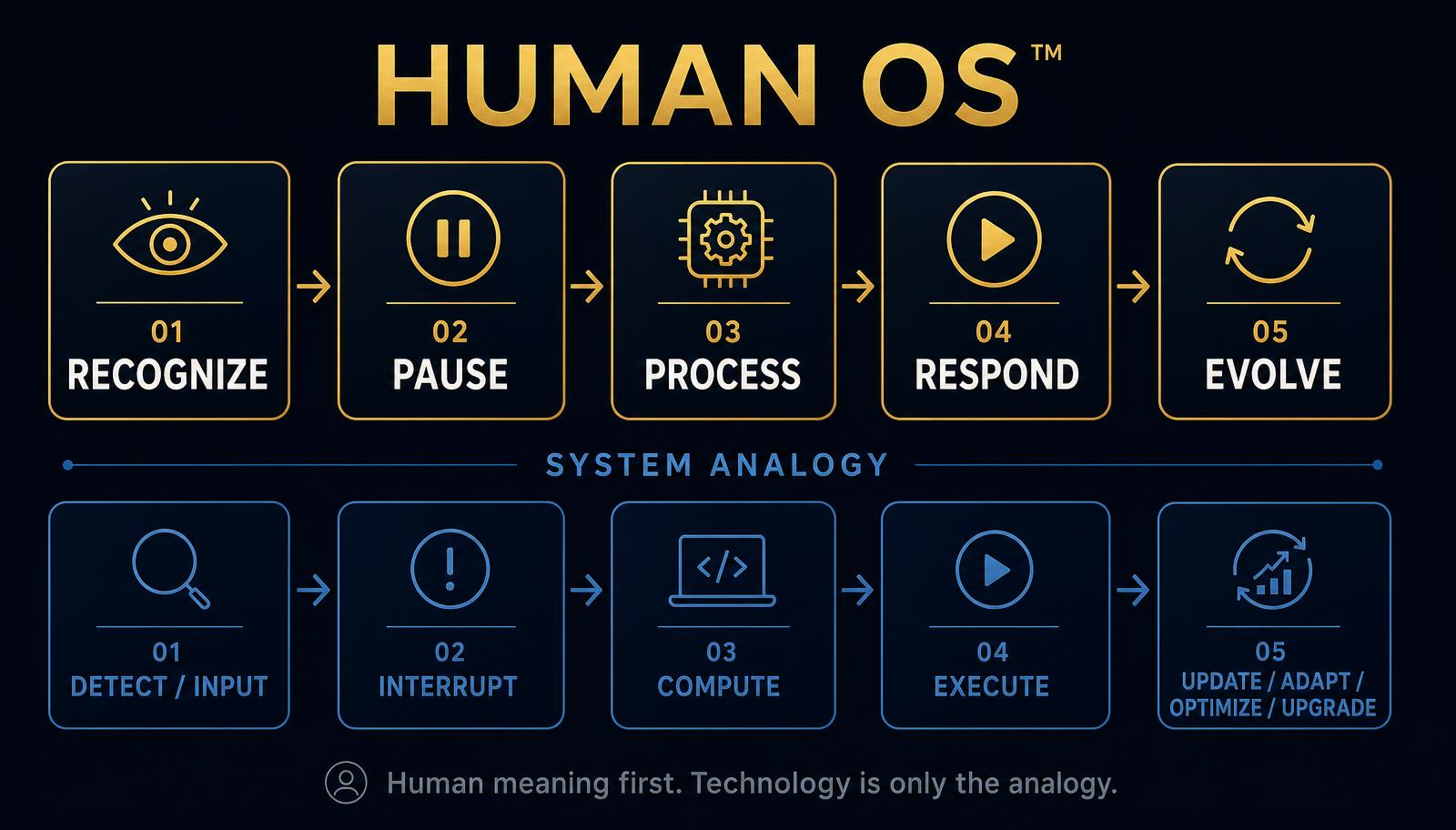
A pocket-sized practice you can run anywhere — at the dinner table, in traffic, mid-argument, mid-scroll.
emergency mental reset
Notice the signal — what's actually happening right now?
Insert a gap between trigger and response.
Run the input through awareness, not autopilot.
Choose an output aligned with who you want to be.
questions to ask yourself
// 06 recent_videos
An introduction to the inner system we all live with.
How toxic narratives slip past our awareness.
Why a 4-second gap changes everything.
// 07 real_world
RM isn't a theory. It's a practice that shows up in classrooms, kitchens, group chats, and quiet moments alone.
Spot the difference between stress and a story your mind is telling about stress.
Pause before reacting — model the awareness you hope your kids will learn.
Recognize compassion fatigue early and run a 'restart' before burnout sets in.
Give students a shared vocabulary for what's happening inside their own heads.
Name the trigger instead of firing the response. Repair, don't rupture.
Defuse meetings, emails, and conflict with a common language for self-awareness.
Notice when a feed is loading a virus into your thinking — and choose to log off.
As machines learn from us, knowing ourselves becomes the most human advantage.
// 08 why_rm_is_different
RM is intentionally narrow. Here's what it is — and what it isn't.
rm is not
rm is
"The goal is not agreement.
The goal is understanding."
// 09 the_origin
Every generation teaches people how to navigate the world around them.
We teach mathematics. We teach science. We teach history. We teach technology.
Yet very few people are ever taught how their own thinking process works.
Many of today's challenges — anxiety, division, misinformation, emotional reactivity, social media addiction, and communication breakdowns — may look like separate problems.
But they often involve the same underlying system:
How humans process information, emotions, beliefs, and experiences.
Rewiring Minds began with a simple question:
What if people understood their own minds as well as they understand their phones, computers, and technology?
RM is an attempt to make that understanding easier, more practical, and more accessible.
// 10 why_the_tech_language
RM does not compare people to machines.
Technology is simply a familiar language that millions of people already understand. Most people know what concepts like inputs, processing, updates, viruses, firewalls, memory, and reboots mean.
RM uses those concepts as metaphors to make complex psychological and behavioral ideas easier to discuss.
Technology becomes the bridge.
Self-awareness is the destination.
The objective is not technical accuracy. The objective is accessibility.
// 10.5 universal_language
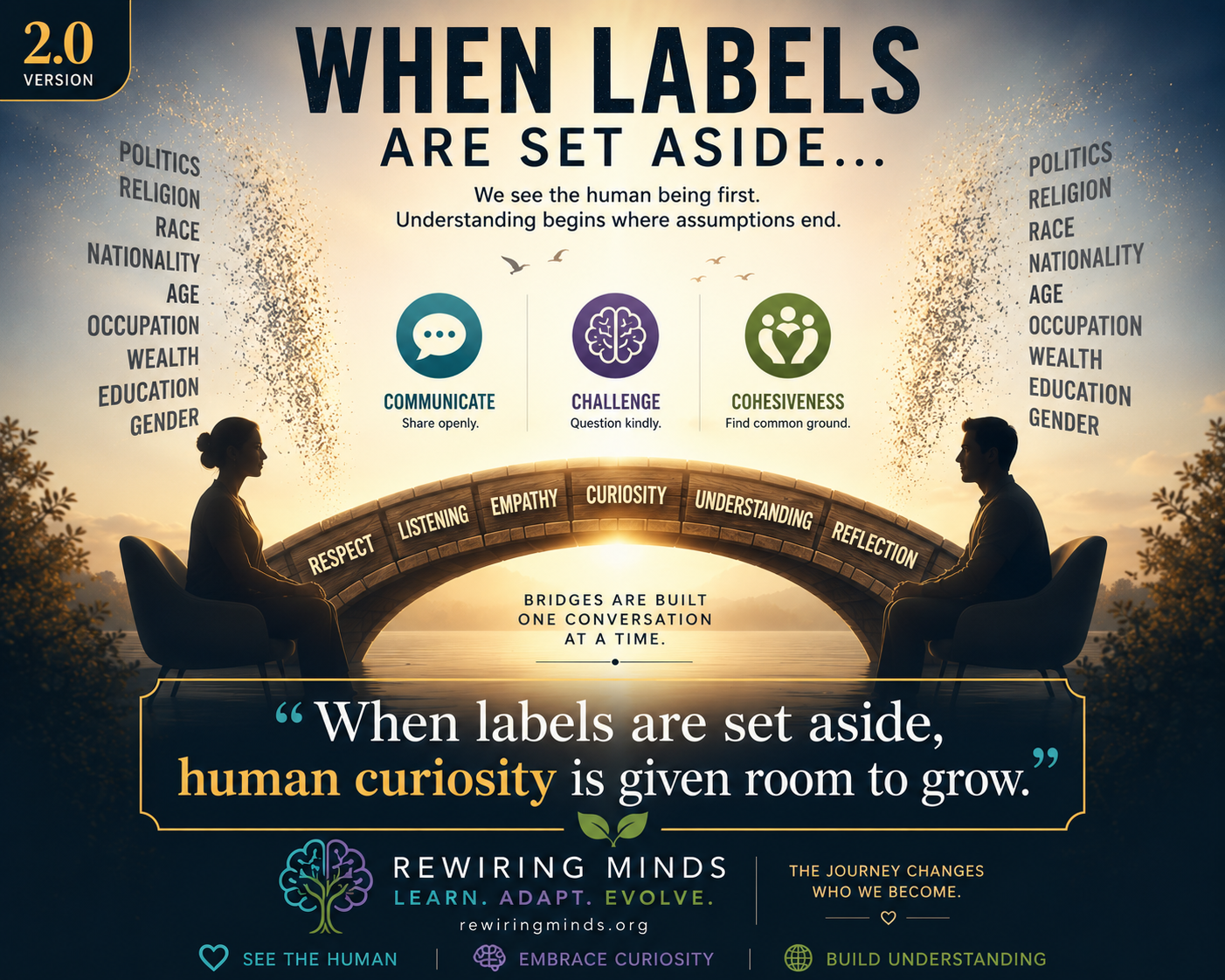
Different cultures. Different beliefs. Shared human experiences.
Human beings may differ in culture, language, politics, religion, education, and life experience.
Yet people everywhere experience thoughts, emotions, stress, communication challenges, relationships, decision-making, habits, and cognitive biases.
Rewiring Minds does not attempt to replace existing beliefs, traditions, cultures, or identities.
Instead, it explores whether technology-inspired language can provide a common framework for understanding how people process information, communicate, react, and make decisions.
The goal is not agreement.
The goal is understanding.
The framework is not tied to a specific nation, political ideology, religion, profession, or generation.
It is intended to remain flexible enough for people from different backgrounds to examine their own thinking processes using language they already understand.
Technology may become humanity's first truly universal language.
RM explores whether that language can be used not only to understand machines —
but to better understand ourselves.
// shared experiences
Human Understanding
Different people. Different cultures. Shared human experiences.
// a_global_conversation
Artificial intelligence is being developed, used, and discussed across nearly every culture and language on Earth.
As technology becomes more connected, humanity may benefit from a shared vocabulary for discussing:
Rewiring Minds explores whether technology-inspired language can help create that bridge.
As technology becomes increasingly global, understanding ourselves may become one of humanity's most important shared skills.
// 10.7 designed_for_humanity
Rewiring Minds was not created for a single nation, culture, profession, political ideology, religion, or language.
It was created around something every human being shares:
The ability to think, feel, communicate, learn, and make decisions.
RM seeks to provide a common language for understanding those processes while respecting cultural differences and individual perspectives.
Human Understanding
// 11 future_vision
Imagine a future where understanding ourselves becomes as common as understanding technology.
Students learn emotional awareness alongside digital literacy.
Parents and children share a common language for discussing emotions.
Workplaces reduce conflict through better communication.
Caregivers recognize burnout before it becomes overwhelming.
Social media users learn to recognize manipulation before reacting.
Increasingly intelligent machines are matched by increasingly self-aware humans.
RM is not trying to predict the future.
It is trying to help people prepare for it.
// 12 about_the_creator
Rewiring Minds did not begin in a classroom, a laboratory, or a boardroom.
It began with a simple observation:
Many of the challenges people struggle with today — anxiety, stress, conflict, misinformation, emotional reactivity, communication breakdowns, and social division — often appear very different on the surface.
Yet many may share a common underlying factor:
Most people are never taught how their own thinking process works.
The idea behind RM emerged from years of observing human behavior, communication, decision-making, and the increasing influence of technology on everyday life.
The goal was not to create a belief system.
The goal was not to tell people what to think.
The goal was to create a simple language that helps people better understand how they think.
RM remains an open framework that continues to evolve through feedback, discussion, testing, criticism, and collaboration.
"The project is not finished.
The conversation is just beginning."
// 12 collaborate
RM is an evolving framework. It improves through discussion, testing, feedback, criticism, research, and collaboration.
we welcome
If you believe the framework has value, help improve it.
If you believe it has weaknesses, help identify them.
The goal is not ownership.
The goal is progress.
// 13 the_human_advantage
As artificial intelligence becomes more powerful,
understanding technology will become increasingly important.
Understanding ourselves may become even more important.
The future may not belong solely to those who understand technology.
It may belong to those who understand both technology and themselves.